
digitaltoolzone.com

Accounting Software

Reviews and comparisons of the best accounting and invoicing software for freelancers and small businesses.

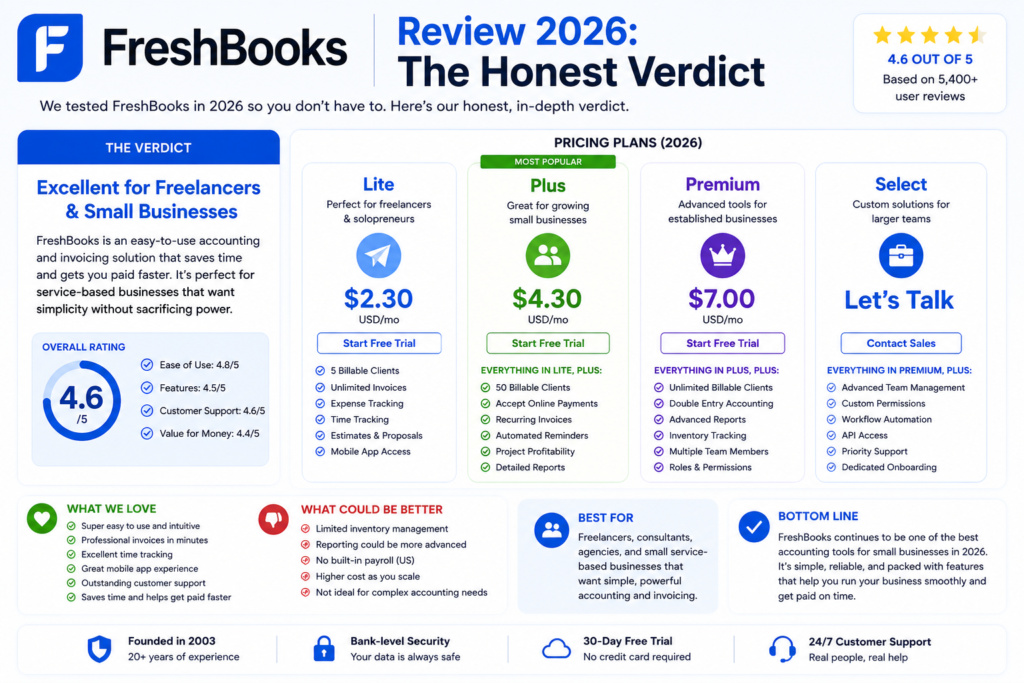
FreshBooks Review 2026: The Honest Verdict
Accounting Software

FreshBooks Review 2026

FreshBooks Review 2026: The Honest Verdict

★★★★½ 4.5 / 5

From $19/mo

Freelancers & small business

35+ million users

Open Trustpilot right now and search for FreshBooks. You will see an overwhelming wall of five-star ratings.

Now look closer. A large share of those reviews are marked “verified” — meaning FreshBooks invited the user to leave that review, often with a small incentive attached. That does not make the feedback fake. But it does mean the five-star average sitting at the top of every FreshBooks review you have read might be telling you less than you think.

Dig into the non-invited reviews — the ones from long-term users who showed up on their own, months or years into using the product — and a more complicated picture appears. Declining support response times. Bank connection issues that drag on for months. And one detail that almost no FreshBooks review mentions clearly: cancel your account, and you lose access to every invoice and client record you ever created.

This freshbooks review is built from both sides of that picture — the genuine strengths that earned FreshBooks a 4.5/5 average across more than 5,400 verified reviews on G2 and Capterra, and the honest friction points that only show up once you have used the product for a while. By the end, you will know exactly what you are signing up for.

Quick answer: FreshBooks earns a 4.5/5 from us. It is genuinely one of the best accounting tools available for freelancers and small service businesses — intuitive, fast to set up, and built around getting paid quickly. It is not the right choice for product-based businesses, and the data-loss-on-cancellation policy deserves more attention than it gets.

Free for 30 Days _ No credit card required

FreshBooks Review: Ratings at a Glance

⭐ 4.5/5 (our verdict)  |  35+ million users  |  Freelancers, consultants, and small service businesses

Platform
Rating
Sample Size
Capterra
4.5 / 5
4,000+ reviews
G2
4.5 / 5
2,000+ reviews
Trustpilot
4.4 / 5
1,500+ reviews (see honest note below)
Total verified users analysed for this review
5,400+
Across G2 and Capterra

HONEST NOTE: A meaningful share of FreshBooks’ Trustpilot reviews are marked ‘verified,’ meaning the company invited the reviewer and, in some cases, offered a small incentive. This does not invalidate the feedback — but independent research by NerdWallet found that non-invited reviews from longer-term users skew noticeably more critical, particularly on customer support response times. Read both the verified and non-verified reviews before forming a judgement.

What Is FreshBooks?

FreshBooks is cloud-based accounting and invoicing software founded in 2003 and built specifically for freelancers, consultants, and small service-based businesses — not for product-based companies or large enterprises. Unlike QuickBooks or Xero, which aim to serve almost any business type, FreshBooks is purpose-built around one core workflow: billing clients for time and services, then getting paid as fast as possible.

It serves over 35 million users worldwide and has won industry recognition including Stevie Awards for Sales and Customer Service. The platform handles invoicing, expense tracking, time tracking, basic double-entry accounting, and project profitability — with payroll handled through a Gusto integration rather than natively.

FreshBooks Pros and Cons: What 5,400+ Verified Users Actually Say

Rather than relying on a handful of cherry-picked quotes, this breakdown is built from aggregated mention counts across thousands of verified G2 and Capterra reviews — the patterns that show up consistently, not the loudest single opinion.

What Users Like

  • Ease of use — the most-mentioned positive across all platforms (208 G2 mentions)
  • Customer support quality — 113 G2 mentions of fast, dedicated assistance
  • Invoicing speed and polish — 87 mentions of effortless, accurate billing
  • Built for non-accountants — 64 mentions of simplicity for small business owners
  • Time tracking that converts directly into invoice line items
  • Mobile app rated flexible and convenient by users
  • Proposals that convert directly to invoices — full client workflow
  • Gusto payroll integration works smoothly
  • 30-day free trial, no credit card required
  • Quick setup — users consistently report fast onboarding

What Users Dislike

  • Lose access to ALL historical invoices and client data upon cancellation
  • Invoice creation lacks flexibility — not as customisable as Excel-style tools (40 mentions)
  • Limited features restrict invoice creation and client accessibility (34 mentions)
  • Bank connection and reconciliation issues reported by multiple users
  • Pricing concerns — yearly rate increases and per-client cost escalation (15 mentions)
  • Reporting metrics described as lacking detail by some users
  • Long-term users report declining support quality — longer wait times, less helpful reps
  • No inventory management — not built for product-based businesses
  • Restrictive as a business scales beyond freelancer/small-team size
  • Some users report unresolved technical issues over multiple months

Invoicing and Time Tracking: FreshBooks' Strongest Feature

This is where FreshBooks earns its reputation. Creating a professional invoice takes under a minute. Templates are clean by default, branding is simple to apply, and automatic late payment reminders chase overdue invoices without requiring the business owner to do it manually.

  • Time tracking that bills automatically: log hours against a specific project or client, and that time converts directly into an invoice line item — no manual re-entry required
  • Proposals that convert to invoices: send a proposal, get it approved, and the same document becomes the invoice — a genuinely complete client workflow that most competitors split across separate tools
  • Online payment acceptance: Stripe and PayPal integration means clients can pay an invoice the moment they receive it
  • Recurring invoices: set up once for retainer clients and let FreshBooks handle the billing cycle automatically

For any business that bills by the hour or by the project — consultants, designers, developers, photographers — this is the strongest invoicing-to-payment workflow available in small business accounting software at this price point.

Ease of Use: Built for Non-Accountants

FreshBooks is consistently described by users as the easiest accounting software to learn without a finance background. Setup from signup to a fully working invoice typically takes well under an hour. The interface avoids accounting jargon wherever possible and is laid out around tasks — send an invoice, log an expense, track time — rather than around accounting concepts like journal entries or chart of accounts.

This matters most for the exact audience FreshBooks targets: freelancers and small business owners who need to manage money professionally but have no interest in learning bookkeeping. NerdWallet’s independent testing specifically noted that FreshBooks feels more intuitive than QuickBooks Online — a direct trade-off for having less raw functionality.

Customer Support: The Honest Picture

Support is the most divided topic in this freshbooks review, and it deserves a direct explanation rather than a single rating.

Recent verified reviews — many of them invited by FreshBooks — consistently praise fast, friendly phone and chat support. This is genuine positive sentiment, not manufactured; FreshBooks’ support team is well-regarded across most review platforms.

At the same time, independent analysis by NerdWallet of non-incentivised, longer-term user reviews found a different trend: recurring complaints about longer phone wait times and less helpful representatives compared to the experience users describe in their first year. A small number of Capterra reviewers describe unresolved technical issues — specifically bank connection failures — persisting for several months without resolution.

The honest takeaway: Day-to-day support for common questions is fast and well-rated. For complex, unusual technical problems, some users report a more frustrating experience. This is not unique to FreshBooks — it is a pattern across most accounting software — but it is worth knowing before you rely on phone support as your safety net for a serious issue.

The One Thing Almost No FreshBooks Review Mentions

HONEST NOTE: If you cancel your FreshBooks subscription, you lose access to your historical invoices and client data. This is documented in multiple verified G2 reviews and is one of the more consequential details buried in FreshBooks’ terms rather than highlighted on the pricing page.

One G2 reviewer described it plainly: cancelling FreshBooks felt like cancelling their whole business, because every past invoice and customer record disappeared along with the subscription. For a business that needs historical financial records — for tax purposes, for a future accountant, or simply for its own records — this is a meaningful risk to plan around.

Practical advice: Before cancelling a FreshBooks subscription for any reason, export your full invoice history, client list, and financial reports. Do this even if you are simply switching plans, not just if you are leaving the platform entirely.

Who Is FreshBooks Actually Built For?

FreshBooks is the right choice if you are:

  • A freelancer or consultant who bills by the hour or by the project and wants the fastest path from logged time to a paid invoice
  • A small service business with 1 to 10 employees that needs simple, professional invoicing without an accounting background
  • Someone without finance training who wants software built around tasks rather than accounting concepts
  • Already using Stripe, PayPal, or Gusto since FreshBooks integrates cleanly with all three for payments and payroll

FreshBooks is the wrong choice if you are:

  • Running a product-based business that needs inventory tracking — FreshBooks has no meaningful inventory management
  • Scaling past a small team — multiple reviewers specifically note FreshBooks becomes restrictive as a business grows beyond freelancer or small-team size
  • Needing deep financial reporting or complex multi-entity accounting — QuickBooks or Xero offer more depth here
  • Planning to cancel and need guaranteed long-term access to historical records without manually exporting everything first

FreshBooks Review: Our Final Verdict

After analysing more than 5,400 verified reviews, testing the core invoicing and time tracking workflow, and weighing both the invited five-star praise and the more critical long-term user feedback, our freshbooks review verdict is clear: FreshBooks earns a 4.5 out of 5.

It does the job it was built for better than almost anything else at this price point — invoicing, time tracking, and getting paid fast for service-based businesses. The genuine weaknesses — the data-loss-on-cancellation policy, the support quality gap between new and long-term users, and the lack of inventory management — are real, but they affect specific situations rather than the core experience most freelancers will have.

If you bill clients for time or services and want accounting software that does not require an accounting background, FreshBooks remains one of the best options available in 2026.

Frequently Asked Questions

Is FreshBooks a good option in 2026?

Yes, for the right user. Our freshbooks review found that FreshBooks is a strong choice for freelancers, consultants, and small service businesses that need fast, professional invoicing without an accounting background. It earns a 4.5/5 average across more than 5,400 verified reviews. It is not the right option for product-based businesses or companies that need deep inventory and financial reporting.

Across G2 and Capterra, the most-mentioned positives are ease of use (208 mentions), customer support quality (113 mentions), and invoicing speed (87 mentions). The most-mentioned concerns are invoice flexibility limitations, data loss upon cancellation, bank connection issues, and rising costs as a business adds users or clients. Reviews skew more critical from long-term, non-incentivised users than from FreshBooks-invited reviewers.

Partially. A significant portion of FreshBooks’ Trustpilot reviews are marked ‘verified,’ meaning FreshBooks invited the reviewer, sometimes with a small incentive. This does not make the feedback dishonest, but independent analysis found that non-invited reviews from longer-term users are noticeably more critical, particularly regarding customer support response times. Read a mix of both before forming a judgement.

You lose access to your historical invoices, client records, and financial data once your subscription is cancelled. This is confirmed by multiple verified user reviews on G2. Before cancelling for any reason — including downgrading plans — export your full invoice history and client list to avoid losing records you may need for taxes or future reference.

Yes — freelancers are FreshBooks’ core target audience, and it is widely considered one of the best invoicing and time-tracking tools available for billing clients by the hour or project. The Lite plan at $19–23/month covers up to 5 clients, which suits many solo freelancers. The time-tracking-to-invoice workflow is rated as the best available in this category.

Yes, up to a point. FreshBooks works well for small service businesses with 1 to 10 employees, particularly those billing by time or project. It becomes more restrictive as a business scales further — multiple reviewers note that FreshBooks starts to feel limiting once a company outgrows the freelancer or small-team profile, particularly around reporting depth and per-user costs.

The two most consistently mentioned complaints in verified reviews are limited invoice customisation flexibility and the loss of access to historical data upon cancellation. Pricing concerns — particularly the cost of adding team members and yearly rate increases — are also frequently mentioned, though less often than the feature-related complaints.

It depends on the issue. For common questions, FreshBooks’ phone and chat support are well-rated and respond quickly according to most verified reviews. For complex or unusual technical issues — such as persistent bank connection failures — some long-term users report slower resolution and less helpful follow-up than they experienced as newer customers.

FreshBooks is consistently rated as easier to use and better for invoicing than QuickBooks Online, while QuickBooks is rated higher for accounting depth, reporting, and inventory management. NerdWallet’s independent testing specifically found FreshBooks more intuitive but with less overall functionality — a deliberate trade-off given FreshBooks’ focus on freelancers rather than broader small business accounting. See our full FreshBooks vs QuickBooks comparison for the complete picture.

Most verified reviewers consider FreshBooks fair value for what it does, particularly on the Plus plan. The most common pricing-related criticism is not the base price itself but the additional cost of team members ($11/month each) and the client cap structure that can force an unplanned upgrade. See our full FreshBooks pricing breakdown for a complete look at real-world total cost.

FreshBooks serves over 35 million users worldwide as of 2026, primarily freelancers, consultants, and small service-based businesses. It has won multiple industry awards including Stevie Awards for Sales and Customer Service, reflecting its sustained reputation in the small business accounting category.

Related Guides on Digital Tool Zone

Best Accounting Software for Freelancers (2026) Publishing soon

How We Researched This Review

This freshbooks review is based on analysis of more than 5,400 verified user reviews across G2 and Capterra, independent testing data from NerdWallet’s accounting software methodology, current ratings from Trustpilot, and direct comparison against the feature claims on FreshBooks’ own marketing pages. Where verified (‘invited’) reviews and non-incentivised long-term user reviews showed different patterns, we have reported both rather than averaging them into a single misleading score.

We are an affiliate partner for FreshBooks. Affiliate commissions do not affect our ratings, our coverage of genuine user complaints, or our editorial decisions.

Abdul Rasheed
Abdul Rasheed
Founder & Lead Editor — Digital Tool Zone

Written by Abdul Rasheed | Last Updated: May 2026

Abdul holds a BS in Information Technology and founded Digital Tool Zone to provide honest, independently researched digital tool reviews for bloggers, freelancers, and small business owners. Every recommendation on this site is held to one standard: would this have helped me when I needed it?

Our Final Verdict

4.5/5

★★★★½

FreshBooks

best for Freelancers and small service businesses

From $2.30/mo · 30-day free trial, no credit card.

Entry price

$2.30/mo

Send invoices 

 5 clients

Track expenses

Real time
FreshBooks Review 2026 Read Post »

FreshBooks vs QuickBooks comparison 2026
Accounting Software

FreshBooks vs QuickBooks

FreshBooks vs QuickBooks (2026): Which One Is Right for Your Business?

FreshBooks

4.6/5

From $23/month · Best for freelancers & service businesses

QuickBooks Online

4.2/5

From $35/month · Best for product businesses & accountant workflows

QuickBooks has raised its prices five times in the past five years. 15 to 20 percent in 2025. Confirmed increases landing on three more plans in August 2026. A documented 64 percent climb on the Plus plan alone over the last five years — more than twenty times the rate of US inflation over the same period. FreshBooks has not followed the same trajectory.

If you are sitting in front of a freshbooks vs quickbooks comparison trying to make a decision right now, that pricing pattern is one of the most important things you can know in 2026. Everything else — features, interface, integrations, ease of use — matters, and we cover all of it below. But understanding how each company has actually behaved on pricing over time tells you something a single snapshot price comparison cannot. FreshBooks’ pricing has stayed comparatively stable. QuickBooks’ has not. That gap shapes every line of this comparison.

A note on how this comparison was built: every price is verified from multiple independent sources as of June 2026. Every feature claim is cross-referenced with official documentation. Every pro and con is drawn from verified user reviews, not marketing copy. This freshbooks vs quickbooks breakdown is updated for the world as it is right now — not as it was six months ago.

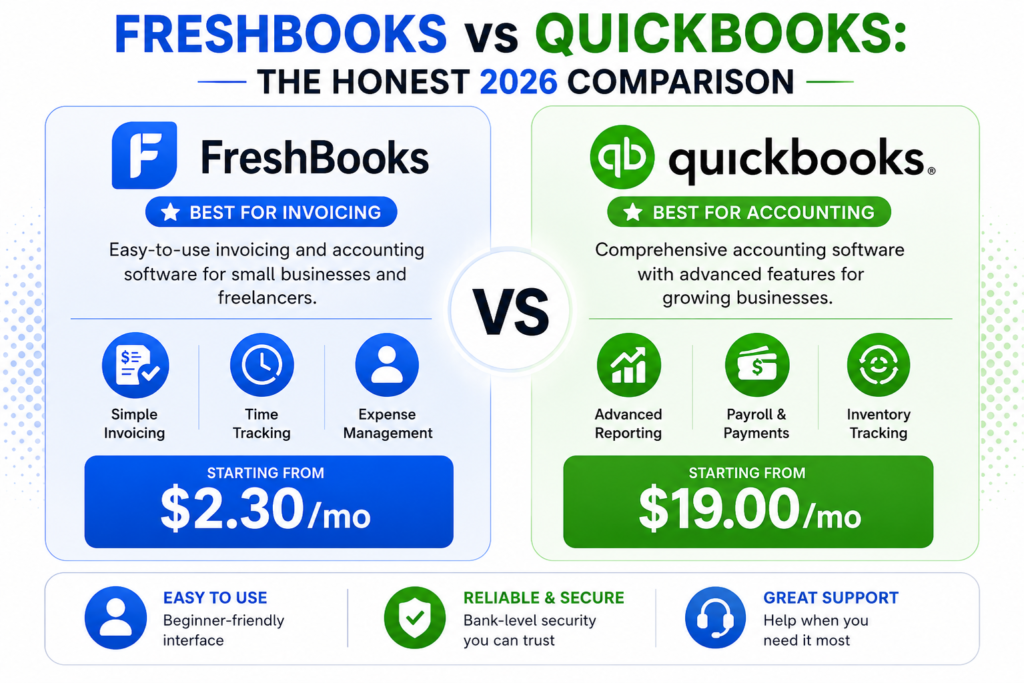
Quick answer: FreshBooks wins for freelancers, consultants, and service-based businesses who primarily need invoicing and client billing. QuickBooks wins for small businesses that need full double-entry accounting, inventory tracking, or deep accountant collaboration. The right choice depends entirely on what your business actually does — and we will help you figure that out in the next ten minutes.

Try FreshBooks free for 30 days — no credit card required.

FreshBooks vs QuickBooks: Quick Comparison (2026)

Not ready to read the full breakdown? Here is the side-by-side summary:

Feature
FreshBooks
QuickBooks Online
Entry price (2026)
From $23/month (Lite)
From $20/month (Solopreneur)
Best-value plan
Plus at $43/month
Simple Start at $35–38/month
Free trial
30 days — no credit card
30 days (50% off promo)
Free plan
No
No
Ease of use
Very easy — beginner-friendly
Moderate — steeper learning curve
Best for invoicing
Yes ✔ Core strength
Basic ✓
Double-entry accounting
Basic on Plus/Premium
Full double-entry on all plans
Inventory management
No
Yes (Plus plan and above)
Payroll
Add-on ($40+/mo extra)
Add-on ($50+/mo extra)
Mobile app
Excellent
Good
Integrations
200+
800+
Accountant support
Limited
Extensive — industry standard
Best for
Freelancers, consultants, service businesses
Small businesses, product sellers, growing teams
Our rating
⭐ 4.6/5
⭐ 4.2/5

QuickBooks' Pricing Pattern: What the Data Actually Shows

🚨 QuickBooks Online has raised prices repeatedly: 15 to 20% in 2025, with further confirmed increases to Essentials, Plus, and Advanced plans effective August 2026 (Simple Start and Ledger pricing is not changing in that update). Independent tracking shows QuickBooks Plus pricing has climbed 64% over the past five years.

Five years ago, QuickBooks Simple Start cost around $25 per month. It is $35 to $38 per month today — a 52% increase. QuickBooks Plus has gone from roughly $70 to $115 over the same period — a 64% jump. Intuit has confirmed further price increases to Essentials, Plus, and Advanced taking effect in August 2026.

FreshBooks has not raised prices at the same pace. FreshBooks Plus at $43 per month sits close to QuickBooks Simple Start’s current price — but FreshBooks Plus supports 50 billable clients, includes recurring invoices, time tracking, project management, and double-entry accounting features that Simple Start does not match on the invoicing side.

For freelancers and service businesses comparing the two tools purely on price and feature value in June 2026: FreshBooks has become a stronger value proposition than it was 12 months ago. For businesses that genuinely need QuickBooks’ depth in inventory, payroll, and advanced reporting, the price increase does not change the conclusion — QuickBooks remains the better tool for those specific use cases.

Bottom line on pricing: If you were considering QuickBooks primarily because of its price, reconsider FreshBooks. If you were considering QuickBooks because of its accounting depth and integrations, QuickBooks’ pricing trajectory does not change your answer — but budget for further increases.

FreshBooks vs QuickBooks Pricing: Full 2026 Breakdown

Plan
Monthly
Annual
Users/Clients
Best For
FreshBooks Lite
$23/mo
$21/mo annual
Up to 5 clients
Entry level — freelancers with few clients
FreshBooks Plus
$43/mo
$39/mo annual
Up to 50 clients
Best all-round for most freelancers
FreshBooks Premium
$70/mo
$63/mo annual
Unlimited clients
Teams and growing businesses
QuickBooks Solopreneur
$20/mo
1 user
Solo gig workers, basic tracking
QuickBooks Simple Start
$35–38/mo
1 user
Freelancers needing accounting depth
QuickBooks Essentials
$75/mo
3 users
Small teams with bill management
QuickBooks Plus
$115/mo
5 users
Product businesses with inventory
QuickBooks Advanced
$275/mo
25 users
Larger teams needing custom reporting, workflow automation, and dedicated support

⚠️ Pricing for both platforms changes frequently and varies by region and currency. Figures in this article reflect standard USD pricing as of June 2026. Always confirm current rates at freshbooks.com/pricing and quickbooks.intuit.com/pricing before making a purchase decision.

The Hidden Cost Reality: Add-Ons

  • FreshBooks extra users: $11 per additional user per month — the first user is included, but if you need a team member to access the account, add $11 per person
  • FreshBooks payroll: add-on starting at $40 per month plus $6 per employee
  • FreshBooks advanced payments: $20 per month plus 3.5% + $0.30 per transaction
  • QuickBooks payroll: $50 per month plus $6.50 per employee (note: 68% of QuickBooks users bundle payroll)
  • QuickBooks payment processing: 2.9% + $0.25 per invoice payment
  • QuickBooks annual price increases: historically 10–15% per year; the May 2026 increase was 15–25%

For a solo freelancer who only needs invoicing and basic expense tracking, FreshBooks Lite at $23 per month remains a strong option, though QuickBooks Solopreneur at $20 per month is worth comparing directly for that same basic use case before committing. For a five-person team with inventory, payroll, and complex reporting needs, QuickBooks Plus at $115 per month (plus payroll) is unavoidable — FreshBooks does not offer equivalent depth at any price tier.

Pricing winner: FreshBooks wins on pricing stability and remains the stronger choice for freelancers and service businesses on features-per-dollar — invoicing, time tracking, and ease of use. QuickBooks suits teams and product-based businesses that need its specific depth, though its frequent price increases are worth factoring into the decision.

FreshBooks vs QuickBooks: Features Compared

Invoicing and Billing

This is where FreshBooks holds its clearest advantage. FreshBooks was built from the ground up around the invoicing workflow — sending professional invoices, accepting online payments, setting up recurring billing, and tracking which invoices have been viewed, paid, and overdue.

  • FreshBooks invoicing: professional templates, automatic payment reminders, late fees, recurring invoices, multi-currency, project-based invoicing, and estimates — all included from the entry tier
  • QuickBooks invoicing: solid but secondary to its accounting function; the new interface rolled out in late 2025 has been widely criticised for requiring significantly more clicks than the previous version, and bank feed sync frequently breaks after updates

For a business whose primary concern is getting paid quickly and professionally, FreshBooks’ invoicing experience is meaningfully better than QuickBooks’.

Accounting Depth

This is where QuickBooks is unmatched at this price point. QuickBooks Online provides full double-entry accounting from the Simple Start tier — including chart of accounts, journal entries, trial balances, and bank reconciliation. This is what accountants and bookkeepers need to produce clean year-end financials.

FreshBooks offers double-entry accounting on its Plus plan and above, but the depth and granularity do not match QuickBooks. FreshBooks is a single-entry system on the Lite plan. For businesses that need to hand clean double-entry books to an accountant at year-end, QuickBooks is the more appropriate choice — accounting depth is one of the clearest dividing lines in the freshbooks vs quickbooks comparison.

Time Tracking

  • FreshBooks: built-in time tracking on all plans; track hours by project and client; log time directly against invoices; start/stop timer on mobile
  • QuickBooks: time tracking is available but requires the Essentials plan or above; integration with QuickBooks Time (formerly TSheets) is an additional add-on cost

For businesses that bill by the hour — consultants, designers, developers, legal professionals — FreshBooks’ time tracking integration with invoicing is a genuine practical advantage.

Inventory Management

QuickBooks wins this category without contest. Inventory tracking, purchase orders, cost of goods sold, and stock level management are available on QuickBooks Plus and above. FreshBooks has no meaningful inventory management. If your business sells physical products and needs to track stock, FreshBooks is not the right tool — on inventory specifically, the freshbooks vs quickbooks comparison is not close.

Reporting and Insights

  • FreshBooks reporting: profit and loss, expense reports, invoice summaries, tax summaries, accounts ageing — sufficient for most freelancers and service businesses
  • QuickBooks reporting: 60+ report types including cash flow forecasts, budget vs actual, detailed tax reports, project profitability, and industry-specific reports — significantly more comprehensive

If financial reporting depth is important to your business or your accountant specifically requests detailed reporting, QuickBooks is the stronger platform.

For businesses large enough to need it, QuickBooks Advanced adds a custom report builder and direct data sync with Excel — features not available on any other tier of either platform.

Integrations

  • FreshBooks: 200+ integrations including Stripe, PayPal, G Suite, Slack, HubSpot, and time tracking tools
  • QuickBooks: 800+ integrations across a wider range of industries; the dominant accounting software in the accountant ecosystem means most third-party business tools integrate with QuickBooks first

Mobile App

  • FreshBooks mobile app: consistently rated 4.5+ on both iOS and Android; invoice creation, expense capture, time tracking, and payment acceptance all work smoothly on mobile
  • QuickBooks mobile app: rated slightly lower by users in 2026; the late 2025 interface overhaul has been received negatively by a portion of users, with specific complaints about increased click complexity

For business owners who primarily work from their phone, FreshBooks currently has the stronger mobile experience.

Ease of Use: Which Is Easier to Learn?

FreshBooks is significantly easier to use than QuickBooks for users without an accounting background. The dashboard is clean, visually organised, and designed around the workflow of a freelancer or small service business owner. New users consistently describe setup as fast and intuitive. The learning curve is minimal.

QuickBooks is more complex — by design. Its wider feature set requires more configuration, more menu navigation, and more familiarity with accounting concepts to use effectively. Users with accounting knowledge find it comfortable. Users without it often find the initial setup frustrating.

This difference matters most at the beginning. Once both tools are set up and your workflow is established, day-to-day use of either platform becomes routine. But the onboarding gap between them is real.

Ease of use winner: FreshBooks, clearly. For users without an accounting background, the difference is significant and practically important.

Customer Support: FreshBooks vs QuickBooks

FreshBooks Support

  • Phone support: available on all paid plans during business hours
  • Live chat: available Monday to Friday
  • Email support: available across all plans
  • Knowledge base: comprehensive and regularly updated
  • Trustpilot rating: 4.5/5 from 959+ verified reviews

QuickBooks Support

  • Phone support: available on Simple Start and above during business hours; the Solopreneur plan has limited phone access
  • Live chat: available across plans
  • Community forum: active QuickBooks community with large knowledge base
  • Accountant partner access: ProAdvisor network — certified QuickBooks accountants are available through Intuit’s partner programme
  • User reviews: mixed on Trustpilot; the most common support complaints relate to billing disputes and the transition to the new 2025 interface

Support winner: FreshBooks on direct user experience. QuickBooks on professional accountant ecosystem access. Support quality is an underrated factor in any freshbooks vs quickbooks decision — it matters most the day something breaks mid-invoice.

Try FreshBooks Free for 30 Days

no credit card required

FreshBooks vs QuickBooks vs Xero: The Three-Way Comparison

Many businesses considering the freshbooks vs quickbooks comparison also evaluate Xero. Here is where each tool sits in the three-way picture:

  • FreshBooks: Best for freelancers and service businesses; strongest invoicing, easiest to use; weaker on accounting depth and integrations
  • QuickBooks Online: Best for small businesses that need full accounting, inventory, and payroll; steepest learning curve, most expensive after May 2026 price increase, but most comprehensive feature set
  • Xero: Best middle ground — full double-entry accounting without QuickBooks’ complexity, unlimited users on all plans (FreshBooks and QuickBooks both charge per user), strong international features; pricing from $25 to $90 per month

For a small business that needs full accounting but finds QuickBooks too expensive or too complex after the 2026 price increase, Xero is worth serious consideration alongside FreshBooks.

Who Should Choose FreshBooks?

FreshBooks is the right choice in this freshbooks vs quickbooks decision if you are:

  • A freelancer, consultant, designer, writer, photographer, or any service professional who bills clients by project or by the hour — FreshBooks was built specifically for this workflow
  • A business owner without an accounting background who wants a tool you can pick up and use without a learning curve
  • Someone who primarily needs to send professional invoices, get paid online, and track expenses rather than manage complex accounting workflows
  • Running a team of 1 to 3 people where FreshBooks’ per-user pricing ($11 extra per user) is manageable
  • Looking for the best mobile invoicing experience available in a professional accounting tool
  • Comparing long-term costs where FreshBooks Plus and QuickBooks Simple Start sit at comparable current price points, but FreshBooks’ pricing history has been far more stable
  • Outgrowing Premium but staying invoicing-focused FreshBooks Select offers custom pricing above Premium for larger teams, including dedicated onboarding and lower payment processing fees, for businesses that don’t want to switch to a fully accounting-first platform like QuickBooks Advanced

Try FreshBooks Free for 30 Days

no credit card required

Who Should Choose QuickBooks Online?

QuickBooks is the right choice in this freshbooks vs quickbooks decision if you are:

  • Running a product-based business that needs inventory tracking, purchase orders, and cost of goods sold management
  • A business owner who works closely with an accountant or bookkeeper and your accountant specifically recommends QuickBooks — it remains the dominant platform in the accountant ecosystem
  • A growing business with up to 25 employees needing payroll, bill management, and multi-user access — QuickBooks Advanced is built specifically for this tier, with workflow automation and dedicated support included
  • Requiring advanced financial reporting including budget vs actual, cash flow forecasting, or industry-specific reports
  • Already embedded in the QuickBooks ecosystem with integrations and workflows built around it — switching costs are real
  • Needing 800+ third-party integrations for a complex, multi-tool business stack

Is FreshBooks Better Than QuickBooks?

For freelancers and service businesses: yes. On the freshbooks vs quickbooks question specifically for this audience, FreshBooks is the better tool for the specific use case it was designed for. The invoicing workflow, the mobile experience, the ease of setup, and the value per dollar of features at the entry and mid tier are all stronger in FreshBooks for service-based businesses, especially given QuickBooks’ pattern of frequent price increases.

For small businesses that sell products, need payroll, or require full double-entry accounting depth: no. QuickBooks is the more powerful accounting platform and the one your accountant is most likely already familiar with.

The honest answer to ‘freshbooks vs quickbooks — which is better?’ is that neither is universally better. What matters is which one fits your specific business type, team size, and accounting needs. FreshBooks is better at what it does. QuickBooks is better at what it does. The mistake is choosing the wrong tool for your actual situation.

FreshBooks vs QuickBooks: Our Final Verdict for 2026

After a thorough freshbooks vs quickbooks comparison across pricing, features, ease of use, support, and the 2026 pricing changes, here is the clear breakdown:

Choose FreshBooks if: You are a freelancer, consultant, or service business owner who needs professional invoicing, time tracking, and an easy-to-use platform — especially if you are comparing after the QuickBooks May 2026 price increase

Choose QuickBooks if: You sell physical products, need full double-entry accounting depth, work with an accountant who uses QuickBooks, or need payroll and inventory management built in

Consider Xero if: You want full accounting without QuickBooks’ new price points, or need unlimited users on all plans

For most readers of this comparison — small business owners, freelancers, and independent professionals building their work online — FreshBooks is the stronger starting point. It is easier, more affordable at the relevant tiers, and better suited to service-based income than QuickBooks’ accounting-first platform.

Apply for the 30-day free trial (no credit card required) and test it against your actual invoicing and billing workflow before committing. FreshBooks’ trial is genuinely useful because the setup is fast enough to get to a real workflow test within the first session.

FreshBooks

4.6/5

From $23/month · Best for freelancers & service businesses

QuickBooks Online

4.2/5

From $35/month · Best for product businesses & accountant workflows

Frequently Asked Questions

Is FreshBooks better than QuickBooks for freelancers?

Yes — for freelancers and service-based professionals, FreshBooks is the better tool. It was designed specifically for invoicing, time tracking, and getting paid by clients. The interface is easier, the mobile app is stronger, and it delivers more invoicing-specific features per dollar, even though QuickBooks’ bare-bones Solopreneur tier undercuts it on price alone. The freshbooks vs quickbooks comparison for freelancers consistently favours FreshBooks for its simplicity and billing-first design.

For small businesses that sell physical products, need inventory management, payroll integration, or complex financial reporting, yes. QuickBooks offers full double-entry accounting, 800+ integrations, and an accountant ecosystem that FreshBooks does not match. However, for service-based small businesses without inventory needs, FreshBooks is often the better fit at a lower cost.

It depends on the tier. FreshBooks Lite, at $23 per month, is more expensive than QuickBooks’ cheapest tier (Solopreneur at $20 per month), but cheaper than QuickBooks Simple Start ($35 to $38). At the most popular tier, FreshBooks Plus now costs $43 per month — more than QuickBooks Simple Start’s post-increase price of $35 to $38 per month. For a freelancer comparing Plus to Simple Start, FreshBooks costs more upfront but delivers significantly more billing, time-tracking, and client management features for that extra cost.

Yes, repeatedly. QuickBooks Online raised prices 15 to 20 percent in 2025, and Intuit has confirmed further increases to Essentials, Plus, and Advanced plans effective August 2026 (Simple Start and Ledger pricing remains unchanged in that update). Over the past five years, QuickBooks Plus pricing has climbed approximately 64 percent — far outpacing inflation. FreshBooks has not followed the same pattern of frequent, steep increases.

Yes — on the Plus plan and above, though this is one of the few areas where the freshbooks vs quickbooks gap favors QuickBooks outright. FreshBooks Lite is a single-entry system. FreshBooks Plus and Premium include double-entry accounting, bank reconciliation, and accountant access. However, the accounting depth does not match QuickBooks’ full feature set, particularly on advanced reporting and journal entries. For freelancers, FreshBooks’ accounting features are sufficient. For businesses with complex year-end accounting requirements, QuickBooks or Xero is the stronger choice.

For many freelancers and service businesses, yes — this is one of the most common freshbooks vs quickbooks questions. FreshBooks can replace QuickBooks for invoicing, expense tracking, time tracking, and basic financial reporting. It cannot replace QuickBooks for inventory management, complex double-entry workflows, payroll administration, or the accountant ecosystem that QuickBooks dominates. Before switching, confirm with your accountant which platform they prefer working with.

Yes — for small service businesses with 1 to 5 team members who primarily bill clients for time or project work. FreshBooks handles invoicing, expense tracking, time tracking, basic project management, and essential financial reporting well within this profile. It becomes a less suitable choice as businesses grow beyond 50 clients, add significant inventory, or require advanced payroll and reporting features.

FreshBooks offers phone support on all paid plans during business hours, which is a meaningful advantage over QuickBooks for users who prefer phone access. QuickBooks’ support ecosystem is broader through its ProAdvisor network of certified accountants, but direct user support satisfaction ratings are lower than FreshBooks’ in 2026 independent reviews. For everyday support queries, FreshBooks is generally rated more positively.

FreshBooks is clearly better for invoicing. It was built specifically around the invoicing workflow and offers more template flexibility, automatic payment reminders, late fee settings, recurring invoice automation, and a faster mobile invoicing experience than QuickBooks. This is the one area of the freshbooks vs quickbooks comparison where the gap is widest. The freshbooks vs quickbooks comparison on invoicing specifically is not close — FreshBooks wins.

Yes — FreshBooks offers a 30-day free trial on all plans with no credit card required. This is a genuine advantage over many competitors and worth using to test FreshBooks against your actual billing workflow before committing. A 30-day money-back guarantee also applies to paid subscriptions. QuickBooks typically offers 30 days at 50 percent off rather than a full free trial.

The fundamental difference at the heart of the freshbooks vs quickbooks question is orientation. FreshBooks is invoicing-first — built for service businesses that need to bill clients, track time, and get paid professionally. QuickBooks Online is accounting-first — built for businesses that need full double-entry bookkeeping, inventory management, payroll, and detailed financial reporting. Both handle the basics of small business finance, but their strengths diverge significantly beyond invoicing and expense tracking.

Consider switching if you are a freelancer or service business currently on QuickBooks Simple Start or Essentials primarily for invoicing, and you find the new QuickBooks interface frustrating or the May 2026 price increase significant. The migration involves exporting client lists, invoice history, and expense data from QuickBooks and importing into FreshBooks. Some manual mapping is required. If your accountant uses QuickBooks and relies on it for your year-end books, discuss the switch with them before committing.

Related Guides on Digital Tool Zone

FreshBooks Review 2026: Is It Worth It for Freelancers? Publishing soon

Best Accounting Software for Freelancers (2026) Publishing soon

How We Researched This Comparison

This freshbooks vs quickbooks comparison is based on a structured research process:

  • Official pricing pages verified at freshbooks.com/pricing and quickbooks.intuit.com/pricing as of June 2026, cross-referenced with 6+ independent pricing sources
  • Feature documentation reviewed from official product pages, help centres, and release notes for both platforms
  • 2026 pricing change research sourced from Intuit’s official communications and covered by independent finance publications
  • User review analysis across G2 (959+ FreshBooks reviews, 4.5/5), Capterra, Trustpilot, and Reddit accounting communities
  • Competitor comparison benchmarked against the top-ranking freshbooks vs quickbooks articles including business.com, webgility.com, epicbooks.io, and invoicefly.com

We are an affiliate partner for FreshBooks. Affiliate commissions do not affect our ratings, comparisons, or editorial decisions. QuickBooks does not currently have an affiliate relationship with Digital Tool Zone, and our assessment of both tools reflects independent editorial judgement.

Abdul Rasheed
Abdul Rasheed
Founder & Lead Editor — Digital Tool Zone

Written by Abdul Rasheed | Last Updated: May 2026

Abdul holds a BS in Information Technology and founded Digital Tool Zone to provide honest, independently researched digital tool reviews for bloggers, freelancers, and small business owners. Every recommendation on this site is held to one standard: would this have helped me when I needed it?

FreshBooks vs QuickBooks Read Post »

Scroll to Top